Wow Writers

From imagination to independence, we inspire every child to find joy in writing, develop strong foundations and grow into confident writers who can communicate their ideas with purpose, creativity and pride.
Intent
We want every child to see themselves as a writer.
Our aim is to help children find joy in writing from the very beginning, developing the confidence to share their ideas, tell their stories and express themselves in ways that feel meaningful to them. We believe that when children enjoy writing and feel successful, they are more willing to take risks, be creative and develop as writers.
We know that strong writing starts with strong foundations. Therefore, we are committed to ensuring that every child develops secure transcription skills, including handwriting, spelling and sentence construction, so that these essential skills become automatic and allow children to focus on communicating their ideas with confidence and creativity.
We want children to understand that writing has a real purpose beyond the classroom. Through meaningful experiences and authentic opportunities to communicate, children learn that writing can inform, persuade, entertain, inspire and create change. We aim for children to make connections between their learning, their experiences and the wider world, helping them see writing as a powerful tool for making sense of ideas and sharing them with others.
Our curriculum is built on the belief that learning is interconnected. As children develop as readers, speakers, thinkers and writers, they draw upon knowledge, vocabulary and experiences from across the curriculum, enabling them to write with increasing depth, understanding and purpose.
Above all, we want writing to be something children look forward to. We strive to create writers who are proud of what they produce, understand the power of their words and leave our school with the confidence, resilience and skills to communicate effectively throughout their lives.
Implementation
Early Writing at Combs Ford Primary School
Inspired by Greg Bottrill, the children in EYFS learn to write through Drawing Club. Drawing Club is a true adventure based on a blend of picture books, tales and animations. Children immerse themselves in the world of stories, share treasure troves of vocabulary and have the opportunity to be creative, using their imaginations to bring pure joy to the process of learning to write. Drawing Club builds strong foundations in early writing, developing children's communication, language and storytelling skills while ensuring they want to write and believe that they can achieve as writers.
In EYFS, these foundations are carefully structured through our Combs Writing Ladder, which supports children's development as early writers. The Writing Ladder provides a clear progression of skills and experiences, helping children build confidence, independence and success from their earliest mark-making through to purposeful writing.
Building on the strong foundations established through Drawing Club, children in Year 1 continue their writing journey through Curious Quests, beginning in Autumn 2. Curious Quests is an immersive adventure through stories, poetry, non-fiction and make-believe that inspires children to become confident, enthusiastic writers.
Through engaging experiences, rich vocabulary and purposeful talk, children develop their ideas before bringing them to life through writing. As they journey through each quest, they strengthen their phonic knowledge, develop secure transcription skills and begin to understand how grammar and punctuation can enhance their writing. We want children to see writing as an enjoyable and meaningful form of communication, building confidence, creativity and independence as they progress.
In Year 2, children continue their Curious Quests journey, further developing their skills as writers through a wide range of text types and writing opportunities. Alongside exploring the features and purposes of different genres, children deepen their understanding of spelling, punctuation and grammar (SPaG), learning how these tools can help them write effectively for different audiences and purposes. Our intention is for children to maintain the joy and creativity fostered through Curious Quests while becoming increasingly skilled, confident and purposeful writers.
How do we organise learning for Years 3 - 6 ?
 Following the success of Curious Quests in Year 2, from September 2026 children will continue their writing journey through an exciting new Year 3 Quest. Drawing on a range of engaging media, children will explore a variety of text types while making meaningful links across the wider curriculum. Interwoven within the Quest is the Combs Ford bespoke writing model, which supports children in developing as confident, purposeful writers through a carefully sequenced approach to writing. Through adventure, enquiry and collaboration, children will continue to 'inventure' their way through challenges, developing the creativity, knowledge and skills needed to write with confidence for a range of audiences and purposes
|
From Year 3 onwards, children follow the Combs Ford Writing Model. Each half term, they embark on a carefully structured writing journey that culminates in two or three high-quality pieces of independent writing. Every unit begins with an engaging immersion phase, where children explore a theme through rich experiences, texts and stimulating activities that inspire ideas and purpose for writing. The journey is then carefully sequenced through six steps, enabling children to develop the knowledge, skills and confidence needed to write successfully and independently. The six steps are explained in more detail below:
|
|
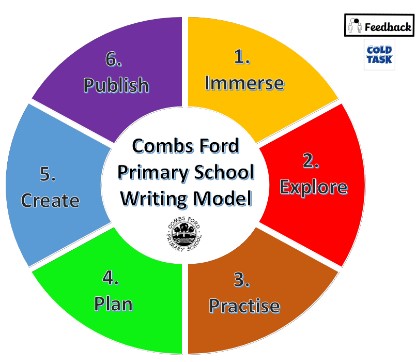
Immerse: Children begin each writing journey by immersing themselves in the unit theme through engaging, memorable experiences. These may include rich texts, drama, debate, role play, videos, visitors or educational visits. A strong emphasis is placed on oracy, giving children regular opportunities to discuss, question, explain, perform and share ideas with others. This stage is designed to inspire curiosity, build background knowledge, develop speaking and listening skills, and enrich children's vocabulary, while providing a meaningful context for their writing.
Explore: During this stage, children explore the features of the text type they will be writing. They are explicitly taught the spelling, punctuation and grammar relevant to the genre and investigate how these features are used by authors. Through analysing a range of examples, children develop an understanding of the structure, content and language choices required for successful writing and create a shared knowledge organiser to support their learning.
Practise: Children apply their developing knowledge through guided writing opportunities. Modelled teaching, discussion and feedback help children experiment with language and structure, building confidence and fluency before moving on to independent writing.
Plan: Children begin planning their own writing with a clear understanding of the purpose, audience and text type (PAT). Wherever possible, writing is rooted in real and meaningful outcomes, helping children understand the value and impact of their work. This stage also draws upon learning from the wider curriculum, enabling children to apply and deepen their knowledge from subjects such as history, geography, science, RE and the arts within their writing. Children may also refine vocabulary, gather information and conduct research to strengthen the quality, accuracy and authenticity of their ideas.
Create: Using their plans, children independently draft their writing. Lessons are carefully structured to support the development of each section of the final piece. Children are encouraged to draw upon the tools, resources and success criteria available to help them write with increasing accuracy, confidence and independence.
Publish: Children celebrate their hard work by publishing a final, polished version of their writing in their neatest handwriting. At this stage, work is assessed against the agreed success criteria and learning objectives, allowing teachers to identify strengths and next steps. Children receive meaningful feedback, helping them to reflect on their achievements and further develop their skills as writers. Published pieces are then shared and displayed to celebrate success and are added to each child's Writing Journey Book, providing a lasting record of their progress, achievements and growth as a writer.
You can find out more about how we structure our Writing teaching in our Writing Expectations below.
Impact
Through our writing curriculum, children develop confidence and enjoyment in writing. They build the knowledge, vocabulary and transcription skills needed to write for a range of purposes and audiences, while making links to their wider learning. Children become increasingly independent, take pride in their work and understand the importance of editing and improving their writing. By the time they leave Combs Ford, pupils are equipped with the skills and confidence to communicate their ideas clearly and effectively.
Subject Leader: Mrs J Aldred (KS1) Mrs H King (KS2)