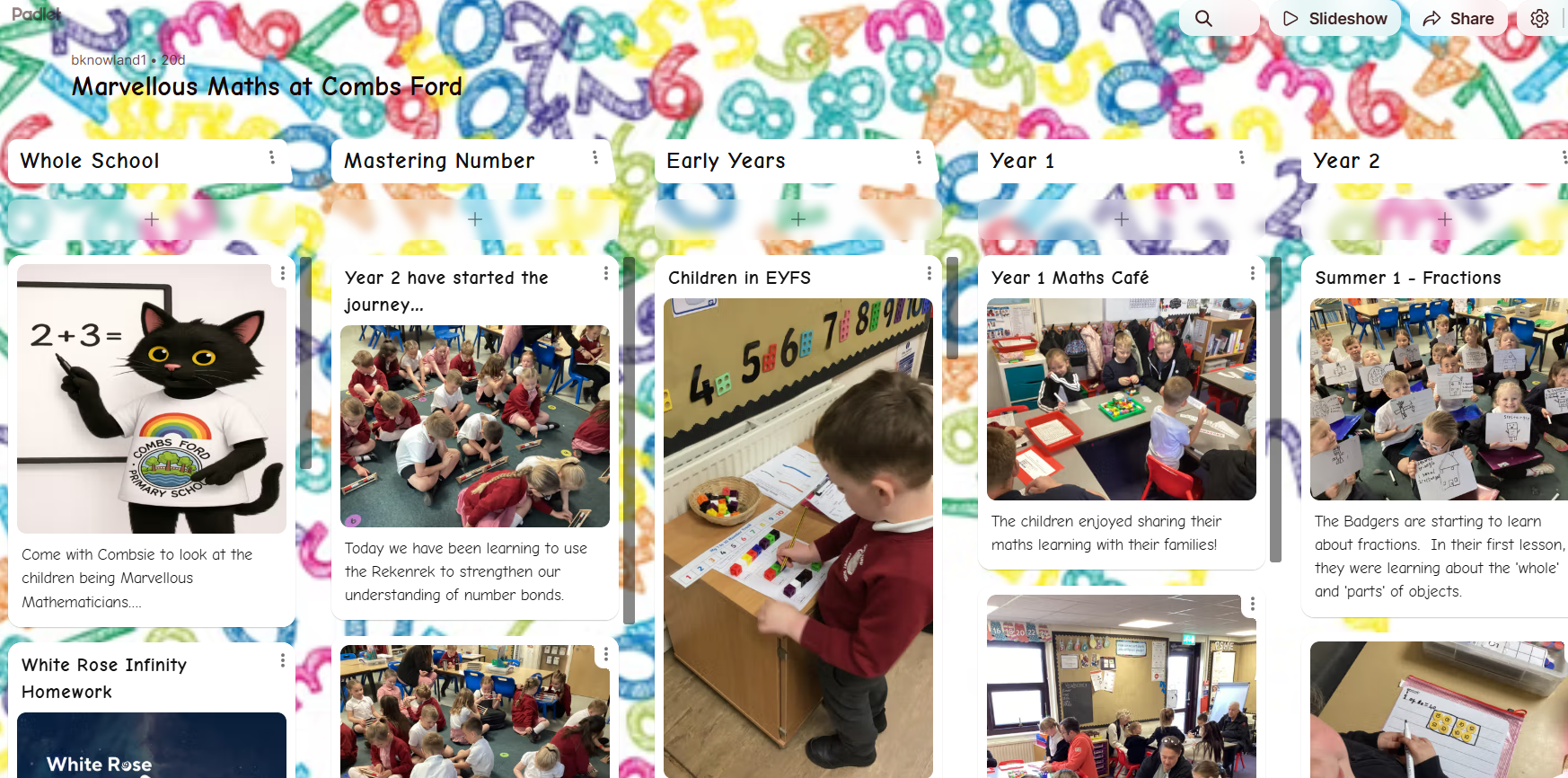
Marvellous Maths at Combs Ford...

Intent
Our mathematics curriculum is designed to promote a mastery approach, ensuring that all pupils develop a deep, secure and adaptable understanding of key mathematical concepts. We follow the White Rose scheme as a foundation for our planning, with lessons carefully adapted to meet the needs of all learners, providing both support and challenge where appropriate.
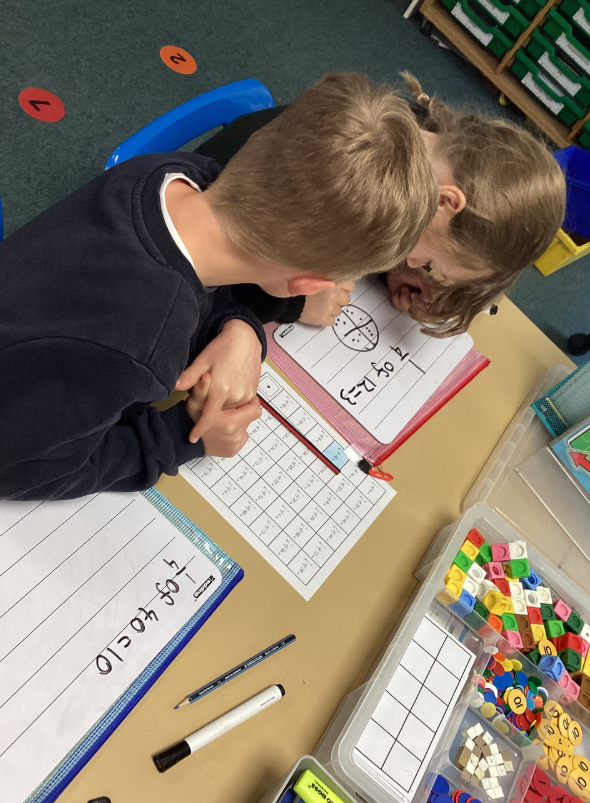
We prioritise the development of fluency, enabling pupils to build confidence and accuracy in their mathematical skills, which in turn supports deeper reasoning and problem-solving. The use of manipulatives and concrete resources is embedded throughout our teaching to help pupils visualise and understand abstract concepts.
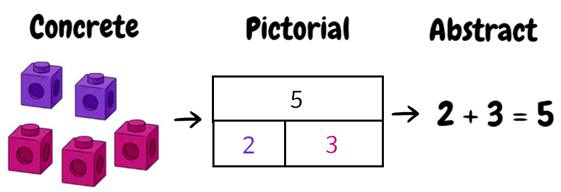
We use the concrete, visual and abstract approach, which helps learners understand abstract concepts first through the use of concrete resources, then pictorial representations before moving on to abstract symbols.
Through our approach, we aim for all pupils to become confident, resilient mathematicians who can apply their knowledge across a range of contexts.
Implementation:
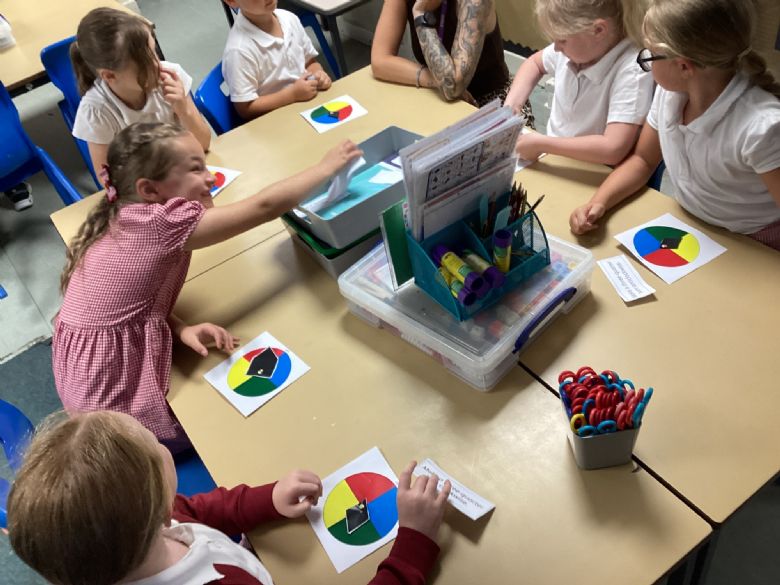
We are committed to creating a learning environment that sparks enjoyment, curiosity and a positive attitude towards mathematics. Our lessons follow a similar format throughout the school, however these are then adapted depending on content of lesson and the needs of the learners.
What does a lesson look like?
- Flashback 4 – 5-minute retrieval starter, questions check retention of past learning.
- Counting – This will encourage children to learn and retain counting in different patterns and then moving onto times tables.
- Entry Ticket – Revisiting learning from current unit of work.
- Whole Class Teaching – The main interactive part of the lesson where children will be taught the new concepts through a back and forth approach following our ‘I do, We do, You do’ teaching style. Lessons will include questioning, practical activities with carefully chosen manipulatives, explanations, demonstrations, problem solving and reasoning. Children will be expected to use precise mathematical language.
- Independent Practice – Children will have the opportunity to apply learning independently or in small group. This work will include a mixture of…

Reflection Time – Usually in the form of a true or false question, children are prompted to reflect on their learning from the lesson.
Where a concept is not yet secure, children will be supported in a variety of ways, including pre-teaching, revisiting concepts, addressing misconceptions, small group teaching and use of concrete resources.
Additional challenge is provided through teachers' careful questioning, explaining their reasoning, open-ended activities and dive deeper challenges.
Mastering Number in KS1
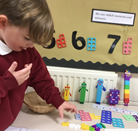
Following on from the great success of Mastering Number in Early Years, KS1 will also be carrying out 4 sessions of Mastering Number each week in Years 1 and 2. This is a programme, run by the NCETM, which aims to secure firm foundations in the development of good number sense for all pupils from Early Years to Year 2. Please click here to find out more

Times Tables Rock Stars
In Key Stage 2, children are further supported in developing rapid recall of multiplication facts through the use of Times Tables Rock Stars, helping to build essential foundations for future learning. This will also help embed times tables in preparation for the Times Tables check in Year 4.
Impact
At Combs Ford, pupils are able to talk enthusiastically about their maths. There is a consistent approach across the school, where children are familiar with models, representations and resources.
Much of the pupils' learning is live marked using highlighter pens (green for ‘got it’, orange for ‘try again’). This allows for instant feedback on their efforts, where teachers can provide additional support or challenge where appropriate. Children will make corrections in lessons so that misconceptions can be addressed and mistakes can be learnt from. Where necessary, additional intervention is provided as quickly as possible to help maintain the whole class working together.
After each unit is complete, an end of unit check is carried out. These are used to inform future arithmetic sessions as well as the Flashback 4 sessions to go over any misconceptions. These results are also shared with parents to keep them informed of their children's learning in maths as well as supporting them at home where necessary. Children complete a termly NFER assessment which assesses their arithmetical fluency and their mathematical reasoning. Results from both of these summative assessments are used to further inform planning and intervention groups.
Have a look at all our Marvellous Maths via our Maths Padlet...(Please click here to view)