Spelling, Punctuation and Grammar
Spelling
From Early Years to Year 2, children follow the Twinkl Phonics programme, where they are taught to spell words progressively through their growing phonic knowledge and understanding of word structure. Alongside this, children learn to read and spell common exception words where phonic decoding alone is not sufficient. Spelling is taught explicitly through both phonics and writing lessons, and children have access to phoneme mats and other supportive resources to encourage independence when selecting graphemes and attempting unfamiliar words.
In Key Stage 1, children take home weekly spellings linked to the graphemes and common exception words being taught in class. They are also given regular opportunities to participate in dictation activities, allowing them to practise and secure key transcription skills without the additional challenge of composing their own writing.
As children move into Key Stage 2, they follow Twinkl's Skip into Spelling programme. This provides a clear, cons istent and progressive approach to spelling that builds seamlessly on the phonics knowledge developed in Key Stage 1. Through discrete spelling lessons, children develop their understanding of spelling patterns, rules, morphology and etymology, helping them become more confident and accurate spellers.
Throughout the school, spelling is reinforced across the curriculum. Children are encouraged to apply their spelling knowledge within their writing, revisit previously taught learning and take responsibility for checking and improving their work. Feedback and marking support pupils in identifying common misconceptions, ensuring spelling is regularly revisited and developed in all areas of learning.
Punctuation and Grammar

Punctuation and grammar are taught throughout the school as an integral part of reading, speaking and writing. We believe that children develop a deeper understanding of grammar when it is taught in meaningful contexts and applied regularly within their own writing.
In EYFS and Key Stage 1, punctuation and grammar skills are developed through Drawing Club and Curious Quests, where children are exposed to rich language and given frequent opportunities to apply taught and modelled skills in purposeful contexts. These skills are also reinforced through daily phonics lessons, helping children to build strong foundations in transcription and sentence construction.
In Key Stage 2, punctuation and grammar are taught through our Combs Ford Writing Model. Key skills are explicitly taught during the Explore stage, where they are carefully selected to link directly to the text type being studied. Children learn the purpose of each grammatical feature, identify it within model texts, practise using it in guided activities and then apply it independently during the Create stage of the writing process. Regular retrieval activities, lesson starters and plenaries provide opportunities to revisit prior learning, strengthen understanding and address misconceptions.
From Year 1 onwards, children also take part in dedicated SPaG Flexi Sessions, which follow a whole-school progression. These sessions revisit previously taught knowledge while introducing new skills, helping children to build confidence and fluency over time. An example of our flex session SPaG plan can be found below.
Assessment is used to identify gaps in learning and inform future teaching. Teachers use evidence from children's writing to identify areas requiring further support, ensuring that punctuation and grammar misconceptions are addressed through targeted teaching in Flexi Sessions, writing lessons and across the wider curriculum.
Handwriting

From EYFS to Year 6, children follow the Penpals Handwriting Scheme, providing a consistent and progressive approach to handwriting across the school.
In EYFS, early handwriting skills are developed through a range of engaging activities within continuous provision. Children are given opportunities to strengthen their fine motor skills, coordination and control through purposeful play and carefully planned activities, helping to build the physical foundations needed for successful writing.
From Year 1 onwards, children take part in more structured handwriting lessons, separate from their writing sessions, following the Penpals programme. These lessons are recorded in handwriting books and include warm-up activities designed to develop posture, pencil grip, strength and coordination before practising letter formation and joins. Opportunities to apply and refine handwriting skills are also provided during phonics, writing lessons and other daily learning activities.
Throughout EYFS and most of Year 1, children learn to form letters accurately using a clear printed script. Children are then introduced to joined handwriting through the Penpals scheme, using the Twinkl cursive unlooped font. This style is then developed and consolidated throughout Key Stage 2, enabling children to write with increasing fluency, consistency and confidence.
Our aim is for all children to develop a legible, fluent and efficient handwriting style that supports them in communicating their ideas clearly and taking pride in the presentation of their work.
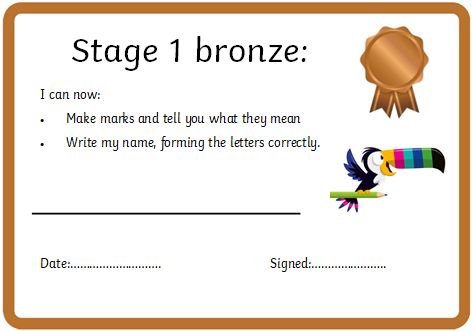
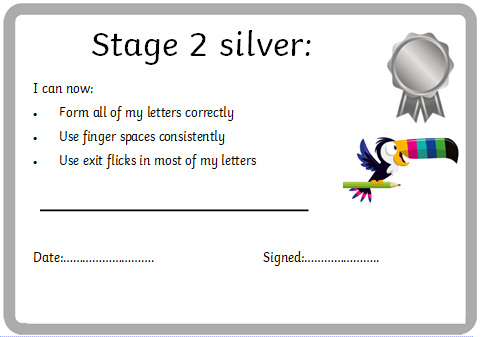
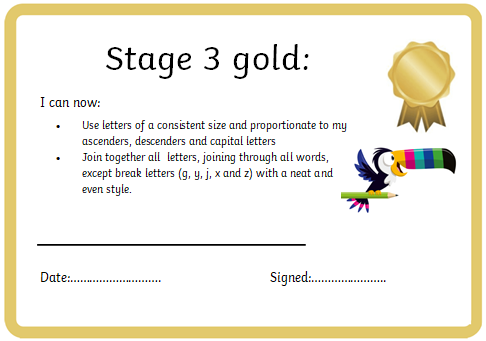
We place a high value on handwriting and celebrate children's achievements through a structured Handwriting Certificate system. The progression is carefully broken down into manageable steps, allowing children to experience success and recognise their improvement over time. Children work towards earning their Pen Licence, which is awarded when they demonstrate consistently neat, fluent and well-presented handwriting across their learning. Handwriting is assessed regularly by teachers to monitor progress, identify next steps and ensure high expectations are maintained. This approach motivates children to take pride in their presentation and supports them in developing handwriting that is accurate, fluent and automatic.
Examples of our certificates are below: